Electrician in South Delhi: 2026 Prices & Hiring Guide
Electrician in South Delhi: 2026 price guide by property type, hidden cost explainer, decision tree, and post-service safety checklist for DDA and…
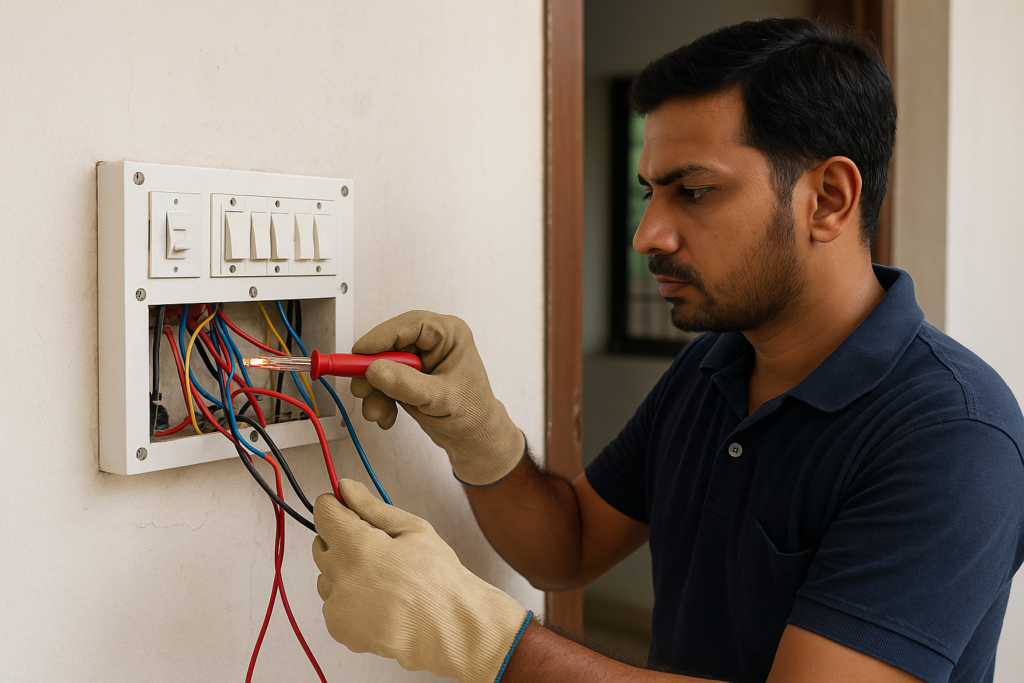
Finding a reliable electrician in South Delhi means knowing which type of property you live in, because a DDA colony flat in Lajpat Nagar and a gated society in Saket have completely different wiring systems, different failure modes, and different price points for the same job. This guide breaks it all down by neighbourhood, property type, and actual cost so you hire right the first time.
In this guide
- How your neighbourhood affects cost and complexity
- Which electrician do you actually need?
- Real pricing by job type
- South Delhi electrical risks to prevent
- Hidden costs in every quote
- Post-service safety checklist
- Frequently asked questions
How your neighbourhood affects cost and complexity
South Delhi isn’t one electrical market. It’s three distinct property types sitting next to each other, each with its own wiring age, load capacity, and repair cost profile.
Lajpat Nagar and Greater Kailash I and II (old DDA infrastructure)
Many flats here date to the 1970s and 1980s and still run single-phase wiring with original copper or aluminium conductors and outdated MCBs (miniature circuit breakers). MCB means the safety switch in your fuse box that trips when a circuit is overloaded. A socket replacement that takes 20 minutes in a new apartment can take an hour here because the wiring behind the socket is brittle, undersized, or has no earthing. Expect to pay 40 to 60 percent more than the base rate for any job in these buildings. Any electrician working here should check earthing continuity before leaving.
Hauz Khas, Safdarjung Enclave, and Vasant Vihar (modern wiring needs)
Builder floors and renovated properties in these areas typically have three-point sockets, separate earthing, and MCB panels installed post-2000. Jobs here are faster and cleaner. A ceiling fan installation that costs ₹500 in Greater Kailash (after the extra diagnostic time) often lands at ₹400 to ₹450 here. But modern layouts have their own hazard: poorly done renovation wiring from informal contractors. Always ask your electrician to check the neutral and earth at every socket they touch.
Saket, Malvir Nagar, and Chhatarpur (builder floors and mixed systems)
Builder floors here vary wildly depending on who built them and when. The ground floor of a three-storey builder floor may have a legitimate MCB panel while the top floor runs exposed conduit wiring installed a decade later by a different contractor. Get the electrician to trace the circuit before quoting. A rewiring job in a builder floor here can range from ₹3,000 to ₹12,000 depending on how much of the existing work needs to be undone.
Which electrician do you actually need?
Not every electrical problem needs the same person. Hire wrong and you’ll waste money or void your building’s electrical compliance.
- A general electrician handles socket replacement, fan fitting, tube light repair, doorbell wiring, MCB replacement. This covers 80 percent of household calls in South Delhi.
- Licensed electrical contractor needed for new house wiring, panel upgrades, earthing installation, or any work requiring a completion certificate from the Delhi State Electricity Board (DSEB). Landlords and home sellers often need this documentation.
- Three-phase industrial electrician is only relevant for commercial shops, restaurants, or homes with heavy three-phase load equipment. Most South Delhi residences run on single-phase supply.
If your MCB trips repeatedly under normal load, that’s a wiring capacity issue, not just a faulty breaker. A general electrician can replace it, but only a licensed contractor should redesign the circuit load distribution. Skip that step and the problem returns within months.
Real pricing by job type in South Delhi (2026)
| Job type | Base range | DDA colony premium |
|---|---|---|
| Socket or switch replacement | ₹200 to ₹400 | Add ₹150 to ₹300 for old wiring |
| Fan installation or repair | ₹400 to ₹600 | Add ₹100 to ₹200 for ceiling height or old bracket |
| MCB replacement | ₹300 to ₹500 | Add ₹200 if panel is outdated |
| New internal wiring (per 5m) | ₹300 to ₹500 | Add 50% for conduit rerouting |
| Full panel upgrade | ₹3,000 to ₹8,000 | Up to ₹15,000 in older buildings |
| Earthing installation | ₹2,000 to ₹5,000 | Varies by soil depth access |
These ranges come from competitor pricing data for South Delhi and are consistent with rates listed by service platforms operating in the area as of mid-2026. Material brand choices (Havells vs. local brands) shift the labour-plus-material total by 20 to 35 percent.
The same socket replacement costs ₹200 in a new Saket apartment and ₹600 in a Lajpat Nagar DDA flat built in 1978. Property age, not the job itself, drives the price difference.
South Delhi electrical risks to prevent now
South Delhi’s climate and power grid create three recurring problems that most competitor articles don’t mention.
- Voltage fluctuations in May and June. Peak summer load on the Delhi grid causes voltage swings that damage inverters, refrigerator compressors, and ACs. A voltage stabiliser on appliances over 1,500 watts is worth the ₹1,500 to ₹3,000 cost. If your appliances are cutting off and restarting without tripping an MCB, voltage fluctuation is the likely cause. Have an electrician check supply voltage with a multimeter before replacing any appliance.
- Monsoon water ingress in old buildings. Exposed conduit on external walls and unsealed junction boxes let moisture into circuits from July through September. Flickering lights during rain, or sockets that feel warm, are warning signs. This needs attention before the monsoon, not during it. Sealing and re-routing exposed sections typically costs ₹500 to ₹2,000 depending on length.
- MCB tripping during peak evening hours. If your MCB trips between 7pm and 10pm in summer, the circuit is overloaded for your current appliance mix. The fix is a load redistribution across circuits, not a higher-rated MCB. Installing a higher-rated breaker without fixing the circuit is a fire risk.
For similar electrical risk patterns in other Delhi districts, the AC repair guide for North Delhi covers voltage fluctuation damage to cooling units in detail.
What’s actually in every quote
A quoted price from a South Delhi electrician typically covers labour only. Here’s what gets added on-site:
- Material markup: Electricians buy materials at trade prices and charge retail or above. Ask for a separate materials list so you can compare.
- Call-out or inspection fee: Some charge ₹100 to ₹200 for visiting, applied toward the job if you proceed. Confirm this upfront.
- DSEB NOC fees: Required for any new connection or panel upgrade. This is a government fee, not the electrician’s margin, but it’s often excluded from initial quotes. Ask directly.
- Rework discovery: Older DDA wiring often reveals problems mid-job that weren’t visible in the initial inspection. A fair electrician flags this before proceeding. If someone raises the price after starting without showing you why, that’s a red flag.
Post-service safety checklist
Before you pay and your electrician leaves, do this. It takes five minutes and catches 90 percent of incomplete work.
- Switch every repaired socket on and off twice. Check for sparking or heat.
- Run the fan or appliance that was installed at full speed for two minutes.
- Check the MCB panel: no breaker should be in a tripped or halfway position.
- Ask the electrician to confirm earthing continuity at any socket they touched. A ₹500 socket tester from any hardware shop in Lajpat Nagar market does this instantly.
- Photograph the finished panel and any new wiring runs before walls are closed. You’ll need this if there’s ever an insurance claim or sale inspection.
- Get a written job completion note with the electrician’s name and contact number.
If your home also needs seasonal maintenance checks, the deep cleaning guide for North Delhi has a room-by-room post-service verification approach worth adapting.
Need a verified electrician in South Delhi with transparent pricing? Find one on InstantWebsite.in and get your Google-reviewed pro in under 90 minutes.
Frequently Asked Questions
What is the cost of electrician in Delhi?
Minor repairs like socket replacement or fuse changes typically cost ₹200 to ₹600 in Delhi. Mid-range work such as fan installation or MCB replacement runs ₹500 to ₹2,000. Major jobs like panel upgrades or full rewiring start at ₹3,000 and can exceed ₹15,000 in older buildings. South Delhi DDA colony properties sit at the higher end of each band because older wiring adds diagnostic and labour time.
What is the minimum charge for an electrician?
Most South Delhi electricians have an effective minimum of ₹200 to ₹300 for any visit, even if the job itself is simple. Some platforms charge a ₹100 inspection fee separately. Budget ₹300 to ₹400 as a realistic floor for any house call, including the simplest socket or switch fix.
What is the salary of electrician in Delhi?
This figure varies widely and isn’t covered in available source data for South Delhi specifically. A general electrician working through a platform or contractor typically earns a daily rate rather than a fixed salary. For accurate current pay data, trade bodies or classified listings in the area are the reliable source.
What is a daily rate for an electrician?
Daily rate pricing is common for larger jobs like rewiring or panel installation. Rates in South Delhi aren’t specified in available source data, but for budgeting purposes, any job quoted as a day rate should include a written scope of what the day covers so you’re not paying for open-ended hours.
South Delhi’s electrical market rewards homeowners who know their property type before calling. In a pre-2000 DDA colony in Lajpat Nagar or Greater Kailash? Budget for higher complexity and ask specifically about earthing and circuit load. In a builder floor in Saket or a modern block in Hauz Khas? The job is usually faster but still needs a post-service check. Get a written quote that separates labour from materials, confirm whether an NOC is needed, and run through the five-point safety checklist before settling the bill.