Water Tank Cleaning in Delhi: The Complete Guide
How often to clean your Delhi water tank, what it costs in 2026, and how to find a verified local service. Complete guide for households and housing…
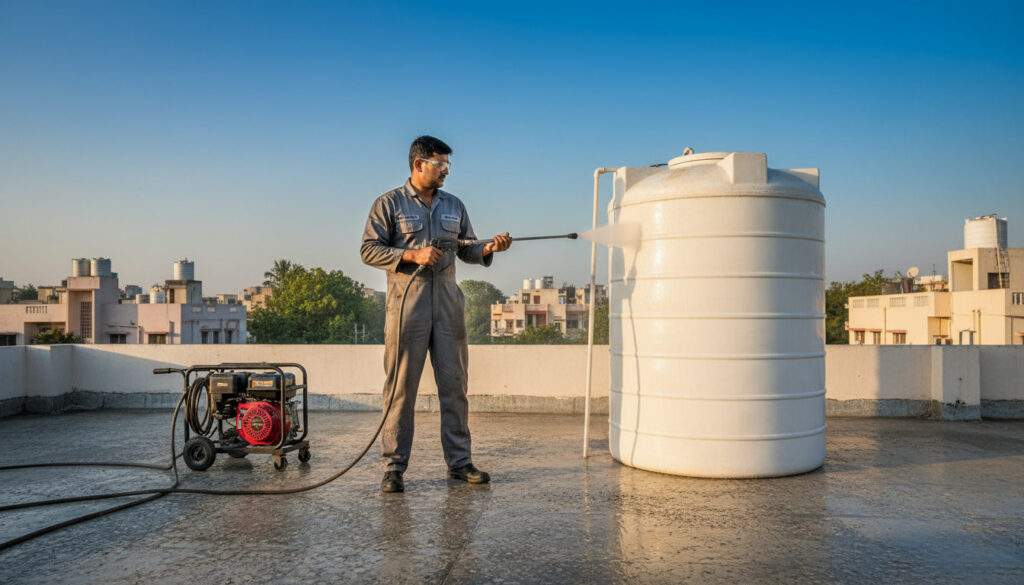
Everything Delhi homeowners and housing societies need to know about water tank cleaning, how often, what it costs, what to look for in a service, and how to avoid getting overcharged.
Water tank cleaning in Delhi should happen at least twice a year, once before summer (March-April) and once before winter (October-November). Most households go 18 to 24 months between cleans. That gap is long enough for sediment, algae, and bacterial growth to build up to levels that affect water quality noticeably. The fix is straightforward and affordable. Finding a reliable service to do it is where most people get stuck.
Delhi’s water supply arrives with sediment. Tankers carry silt. Overhead tanks collect dust, bird droppings, and organic matter year-round. Underground sumps are dark, warm, and wet, exactly the conditions bacteria prefer. Even if your water looks and smells clean coming out of the tap, the inside of an uncleaned tank tells a different story.
This guide covers what a proper water tank clean involves, how to price-check any quote you receive, the difference between underground and overhead tank cleaning, and how to find a verified service in Delhi that won’t disappear after taking your money.
Why Regular Tank Cleaning Matters in Delhi
Delhi’s piped water supply from Delhi Jal Board (DJB) is treated before it reaches your building. But between the treatment plant and your tap, the water passes through aging municipal pipes, your building’s underground sump, a pump, and your overhead storage tank. Each of those points can introduce contamination, and the tank is where it accumulates.
Sediment settles at the bottom of any tank over time. In Delhi, where tanker water supplements DJB supply in many areas, that sediment includes sand, silt, and rust particles from older tanker trucks. On top of the sediment layer, biofilm forms, a thin coating of bacteria that standard household filters don’t fully remove.
What actually grows in a neglected tank
Algae appears in tanks with any light exposure. It’s not immediately dangerous, but it degrades water taste and creates conditions where other organisms thrive. E. coli and coliform bacteria show up in tanks contaminated by bird droppings or structural cracks. Legionella, though less common in domestic tanks than in commercial cooling systems, has been found in large underground sumps in residential complexes.
The households most at risk from dirty tanks are the ones who filter their water at the tap and assume the filter handles everything. A good RO system removes chemical and bacterial contamination at the point of use, but sediment and biofilm buildup in your tank degrades filter performance and lifespan. Clean tank, longer-lasting filter. It’s a direct connection most people don’t make.
How Delhi’s water supply makes this worse
Many DJB supply areas experience intermittent pressure. Low-pressure supply means tanks are drawn down fully before refilling, which stirs up any settled sediment. Areas dependent on tanker supply face additional contamination risk because tanker hygiene standards vary widely and are difficult for the end customer to verify.
The Delhi Jal Board recommends cleaning household storage tanks at least twice annually. The Bureau of Indian Standards (BIS) standard IS 12112 covers water tank design and maintenance for domestic use. Neither body enforces household cleaning compliance, it’s entirely on the resident or RWA to maintain their own tanks.
What a Proper Water Tank Clean Actually Involves
A legitimate water tank cleaning service follows a process. It’s not complicated, but each step matters. If a service skips any of these, the clean is incomplete, and you’re paying for something that doesn’t solve the problem.
The Six Steps of a Complete Tank Clean
Ask the service provider before they arrive: “Do you use a pressure washer?” Services that use only mops and buckets don’t remove biofilm effectively. Pressure washing is the step that distinguishes a genuine clean from a cosmetic one. A good service will answer this question without hesitation.
Chemicals used: what’s safe, what isn’t
Sodium hypochlorite (bleach) at a dilution of 50 parts per million (ppm) is the standard disinfectant for potable water tanks. This is the same compound used in municipal water treatment, at appropriate concentration. At the right dilution, it’s safe and effective. At wrong concentrations, it leaves residue that affects water taste.
Some services use quaternary ammonium compounds (QACs) instead. These are effective biocides but not always suitable for potable water contact surfaces. Ask what chemical your provider uses and whether it’s approved for potable water tank use. A professional service will have this information and share it without prompting.
Overhead vs Underground Tanks: What Changes
Delhi homes typically have two storage points: an underground sump (where water enters the property from the municipal supply or tanker) and an overhead tank (where water is stored after being pumped up). Both need cleaning. They’re different jobs.
Overhead Tank vs Underground Sump Cleaning
Housing society RWAs often get a single quote for “water tank cleaning” that covers only the overhead tanks on each building, not the main underground sump. The sump is typically the larger contamination risk and the more expensive clean. Always confirm in writing which tanks are included in any quote for a housing society.
“Cleaning only the overhead tank without cleaning the underground sump is like mopping the kitchen floor without cleaning the bucket you’re mopping with. The dirty sump recontaminates whatever you just cleaned.”
Water Tank Cleaning Costs in Delhi: What’s Fair
Pricing in Delhi’s water tank cleaning market varies widely. The range below reflects typical market rates as of 2026. Quotes significantly below these numbers usually mean shortcuts on equipment or process. Quotes well above them may reflect genuine quality, ask what’s included.
| Tank type | Capacity | Typical price range (Delhi, 2026) | Time required |
|---|---|---|---|
| Overhead plastic tank | 500-1,000 litres | ₹1,200 to ₹2,000 | 1 to 1.5 hours |
| Overhead plastic tank | 1,000-2,000 litres | ₹1,800 to ₹3,000 | 1.5 to 2 hours |
| Underground sump (residential) | 5,000-10,000 litres | ₹3,500 to ₹6,000 | 2 to 3 hours |
| Underground sump (housing society) | 10,000-50,000 litres | ₹8,000 to ₹25,000+ | 4 to 8 hours |
These prices include draining, scrubbing, pressure washing, and disinfection. They do not include structural repairs (cracks, broken lids, corroded inlet pipes), those are quoted separately and priced per repair.
Per-litre pricing vs fixed pricing
Some services quote per litre (typically ₹0.80 to ₹1.50 per litre). This can work in your favour for large tanks and against you for small ones. A 500-litre tank quoted at ₹1.50/litre comes to ₹750, below the minimum viable cost for a proper job with pressure washing equipment. Treat any per-litre quote below ₹1.00 with scepticism for small tanks.
How to Find a Reliable Service in Delhi
Where to Find Verified Water Tank Cleaners in Delhi
Before booking any service, ask three specific questions: Do you use a pressure washer? What chemical do you use for disinfection, and what concentration? Will you send photos of the tank before and after? A professional service answers all three without hesitation. One that deflects or says “we use the best chemicals” without specifics is worth skipping.
Browse verified water tank cleaning services in Delhi
Real Google reviews displayed. Verified contact details. No middleman markup.
Free to browse · Verified listings · Call directly with no platform fees
Red Flags to Watch For
The water tank cleaning market in Delhi has a significant number of operators who take money for an incomplete job. Not scammers, exactly, they’ll show up and do something. But “something” isn’t the same as a proper clean.
Six Red Flags in Any Water Tank Cleaning Quote
Pay only 50% upfront, 50% on completion. Any professional service accepts this arrangement. A service that demands full payment upfront before arriving has no incentive to do the job properly. This one rule eliminates most bad experiences.
Five Rules Every Delhi Household Should Follow
- 01Clean twice a year, minimum. March-April before summer heat accelerates bacterial growth. October-November before winter, when tanks are typically fullest and left undisturbed longest. Mark it in your calendar as a recurring appointment, not something to get around to.
- 02Keep tank lids sealed and in good condition. A cracked or missing lid is the single biggest contamination risk for overhead tanks. Bird droppings, dust, and insects enter through open lids. Replacing a broken lid costs ₹200 to ₹800 depending on tank model. That’s a small cost for what it prevents.
- 03Clean both tanks, not just one. Cleaning only the overhead tank without addressing the underground sump means your freshly cleaned tank is being refilled from a dirty sump. Both tanks are part of the same water system. Both need attention on the same schedule.
- 04Document every clean. Ask for a photo or written record of the work done, the chemicals used, and the date. This matters for housing society records, for tracking cleaning frequency, and for any dispute about water quality afterward.
- 05Book a service with a Google presence you can verify. The days of trusting a flyer or a random referral without checking online first are over. Spend two minutes checking the service’s Google reviews before booking. A service with 50 reviews averaging 4.7 stars has built that reputation over dozens of completed jobs. That matters.
Frequently Asked Questions
How often should I clean my water tank in Delhi?
At least twice a year. Delhi Jal Board guidelines recommend this minimum frequency. In areas that rely heavily on tanker supply, or if you have young children, elderly family members, or immunocompromised household members, cleaning every four months is the better standard. The cost is low enough that erring on the side of frequency makes sense.
What is the typical cost of water tank cleaning in Delhi?
A standard 1,000-litre overhead tank costs ₹1,500 to ₹2,500 for a complete professional clean including pressure washing and disinfection. Underground sumps start at ₹3,500 for residential sizes. Housing society main sumps range from ₹8,000 to ₹25,000+ depending on capacity. Any quote significantly below these figures should be questioned.
How long does water tank cleaning take?
A standard overhead tank (500 to 1,500 litres) takes one to two hours from start to finish. Underground sumps take two to four hours. Large housing society sumps can take a full day. Add the waiting time after disinfection (minimum 30 minutes, ideally longer) before you can refill and use the water.
Is the water safe to use immediately after cleaning?
No. After disinfection, the tank should be rinsed and then refilled. Run taps briefly once refilled to flush disinfectant residue from supply pipes. Most professional services recommend waiting 30 to 60 minutes after the final rinse before using the water for drinking or cooking. Your service provider should confirm this timing based on the chemical they used.
Do I need to clean my tank if I use an RO water purifier?
Yes. An RO purifier treats water at the point of use, but heavy sediment and bacterial load in your tank degrades your purifier’s pre-filters faster, shortens the RO membrane’s lifespan, and increases maintenance costs. A clean tank is better for your purifier’s performance and running cost, not just your water quality.
Can I clean my water tank myself?
You can drain and scrub an overhead tank yourself safely. The challenge is effective disinfection (correct chemical, correct concentration, correct contact time) and the physical access required for underground sumps. Underground cleaning carries confined space safety risks and should only be done by a professional with proper equipment. For overhead tanks, a professional clean costs little enough that DIY isn’t worth the risk of doing it incorrectly.