Water Tank Cleaning in Bangalore: 2026 Prices & Guide
Water tank cleaning in Bangalore costs ₹779, ₹1,449. Learn when to clean, how to inspect your tank, and how to spot a bad service. 2026 guide.
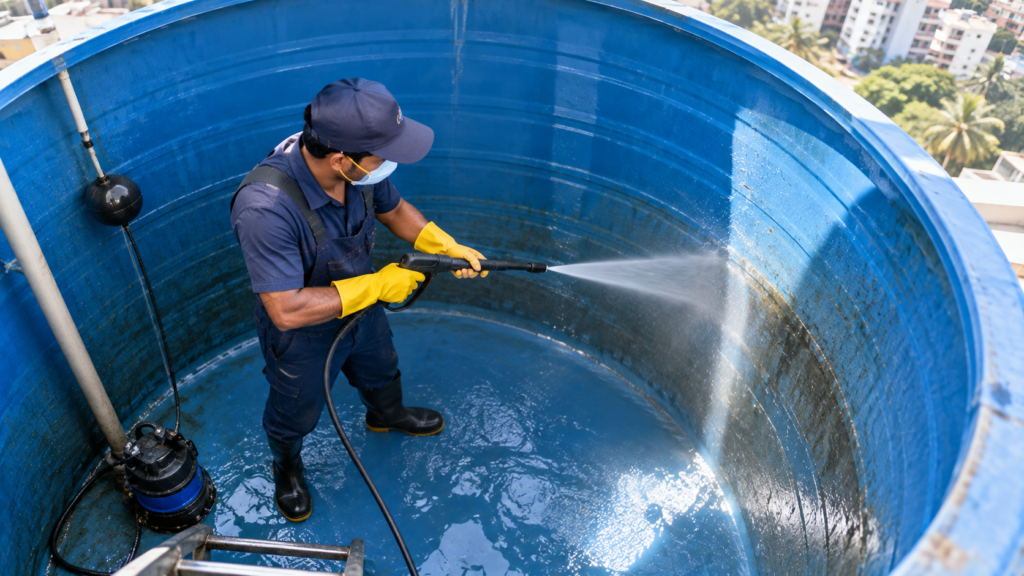
Water tank cleaning in Bangalore typically costs between ₹779 and ₹1,449 for a standard residential tank, depending on capacity and tank type. But here’s what actually matters: price is almost irrelevant. Bangalore’s groundwater is notoriously hard, and seasonal contamination risks mean the timing and quality of a clean matter far more than saving ₹200.
In this guide
- Why Bangalore tanks need extra attention
- When to clean: a seasonal schedule
- Tank material matters
- Pre-service inspection checklist
- Red flags to avoid
- Frequently asked questions
Why Bangalore tanks need extra attention
Bangalore’s municipal water supply (BWSSB) blends Cauvery water with groundwater in many areas. Cauvery water is soft. Borewells? Different story entirely. In Whitefield, Sarjapur Road, Hebbal, and parts of Jayanagar, you’re pulling hard water with high TDS (Total Dissolved Solids) straight from underground. Hard water deposits calcium and magnesium scale on tank walls, and that scale traps sediment and creates rough surfaces where bacteria colonise faster than in smooth tanks.
Then add Bangalore’s climate into the mix. Hot dry summers encourage algae growth in inadequately covered tanks. June through September, the monsoon pushes surface runoff and insects through loose or cracked lids. Winter is mild, which means water sits longer in lower-usage tanks. The result is straightforward: a tank here accumulates more contamination vectors than in a drier, single-source city.
Tanks with visible green or black discolouration on interior walls carry a higher bacterial load. Want a baseline? A simple TDS meter (under ₹500 online) gives you readings before and after cleaning to verify whether anything actually improved.
When to clean: a seasonal schedule for Bangalore
Most services recommend cleaning every six months. That’s baseline. But timing is everything. Clean once in April or early May, just before summer heat peaks and algae growth accelerates. Then clean again in October or November, after monsoon ends and before post-monsoon sediment hardens into layers.
| Tank type | Recommended frequency | Reason |
|---|---|---|
| Plastic (HDPE overhead) | Every 6 months | UV degradation over time, algae on opaque surfaces |
| Cement / concrete sump | Every 4-6 months | Porous walls trap bacteria, cracks develop in Bangalore heat |
| Stainless steel | Every 6-12 months | Smoother walls, but joints corrode in hard-water areas |
| Fibre (FRP) | Every 6 months | Light-permeable if older, promotes algae |
Need more detail? Check out this guide to water tank cleaning in Chennai, which covers similar borewell-dependent households across South India.
Tank material: what changes about the cleaning process
Concrete sumps in older apartments (Malleswaram, Rajajinagar, Basavanagudi) crack over years of use. And cracks? Scrubbing alone won’t fix a contamination problem that deep. A good technician inspects for cracks and recommends waterproof sealing before disinfection. Skip this step, and the clean won’t last past the next monsoon.
Plastic tanks. Bangalore’s heat degrades them faster, especially if they’re rooftop-mounted without shade cover. UV damage makes walls brittle and micro-porous. Once they’re over eight to ten years old, replacement makes more sense than repeated cleaning. Ask the technician to check wall thickness and any yellowing.
Metal tanks corrode at joints.
Hard borewell water accelerates this. Scale buildup inside a metal tank speeds corrosion. So cleaning should include descaling, not just sludge removal.
Pre-service inspection checklist
Do this before the technician arrives. It takes five minutes and gives you a baseline to compare against after the job.
- Check the tank lid: is it cracked, loose, or missing a seal? Insects and debris enter here during monsoon.
- Smell the water from the tap nearest to the tank. Musty or earthy means microbial growth.
- Check the overflow pipe: is it screened? An open pipe invites mosquitoes (a real dengue risk in Koramangala, BTM Layout, and Electronic City during monsoon).
- Note the water colour when the tank is nearly empty. Yellow tint means rust or sediment. Green tint means algae.
- If you have a TDS meter, measure before cleaning and note it down. Post-clean reading should be lower if the tank is on borewell supply and the technician descaled properly.
Document this with phone photos. A good cleaning service won’t object to you showing them what you found. A service that gets defensive about a pre-inspection checklist is telling you something important.
How to spot a bad cleaning service
The market for tank and sump cleaning in Bangalore is crowded. The gap between a thorough job and a cursory one isn’t visible to the naked eye. Watch for these signs.
- No disinfection step. Scrubbing removes sludge but doesn’t kill bacteria. A proper clean ends with a food-grade disinfectant (usually chlorine-based) applied to all interior surfaces and left to dwell before rinsing.
- Finished in under 30 minutes for a 1,000-litre tank. A proper drain, scrub, disinfect, and rinse cycle takes 60 to 90 minutes minimum per hometriangle.com’s listed service times.
- No inspection report or job card. Reputable services provide written documentation of what was done. Housing societies need this for their records.
- Using regular household cleaning agents instead of food-safe chemicals. Ask what disinfectant they use. Can’t name it? Don’t proceed.
- Refusing to show the interior after draining. You should see the walls before scrubbing begins.
The same vetting principles apply to other home services in Bangalore. See how pest control in Bangalore approaches operator verification.
Post-cleaning maintenance to extend intervals
A clean tank stays clean longer with a few simple steps. Fit a mesh screen on the inlet pipe to catch debris. Check and reseat the lid seal after every monsoon. If your building uses borewell water, fit an inline sediment filter on the supply line (50-micron filter is enough for most residential setups). Flush 10 to 15 litres from the lowest tap after refilling to clear any loosened sediment from pipes.
Apartment residents in Hoodi, HSR Layout, and Hennur Road (where water supply is irregular) should be extra careful. Tanks that cycle between near-empty and full refill more sediment per litre than continuously topped-up tanks.
A tank cleaned in April and maintained with a screened lid and inlet filter will stay within safe parameters through monsoon without a mid-year clean. Skip the maintenance, and you’re back to square one by August.
Need a verified water tank cleaning service in Bangalore? Find rated local operators on instantwebsite.in and check real Google reviews before booking.
Frequently Asked Questions
How much does it cost to clean out a water tank?
In Bangalore, residential water tank cleaning starts at around ₹779 for a basic clean (drain, scrub, sludge removal) and runs to ₹1,449 or more for a full-service clean that includes inspection, disinfection, and a job card. Larger capacity tanks above 5,000 litres, or commercial and society sumps, are priced separately and typically quoted on-site.
How much does it cost to clean a septic tank in Bangalore?
Septic tank cleaning (desludging) is a distinct service from water tank cleaning and involves tanker trucks and specialised equipment. Pricing in Bangalore varies by tank size and access; the SERP data available doesn’t include a confirmed figure for septic tank cleaning specifically, so get at least two written quotes from BBMP-registered operators before committing.
How do you clean a 5000 litre water tank?
A 5,000-litre tank requires draining completely, then physical scrubbing of all interior walls and the base to remove sludge and scale. After scrubbing, a food-grade disinfectant is applied to all surfaces and left to dwell (usually 15 to 20 minutes), then the tank is rinsed and refilled. For concrete or cement tanks of this size, check for wall cracks before disinfecting and seal any found before refilling. The full process takes 90 minutes to two hours.
How often should water tanks be cleaned?
Every six months is the standard recommendation for most residential tanks in Bangalore. Concrete sumps in older buildings or tanks fed by borewell water may need cleaning every four months due to faster scale and sediment buildup. Timing cleans for April (pre-summer) and October (post-monsoon) targets the two highest-risk periods in Bangalore’s climate.
The ₹200 difference between a cheap and a proper cleaning service isn’t where the value sits. The value sits in finding a technician who disinfects, documents, and checks your tank material before scrubbing. Book ahead of monsoon and again in October. Maintain the lid and inlet screen between visits. That routine, applied consistently, means cleaner water and fewer emergency bookings.