Water Tank Cleaning in South Delhi: Prices & How to Pick Right
Water tank cleaning in South Delhi costs ₹0.80/litre. Compare prices by area, traditional vs non-invasive methods, and how to pick the right service near…
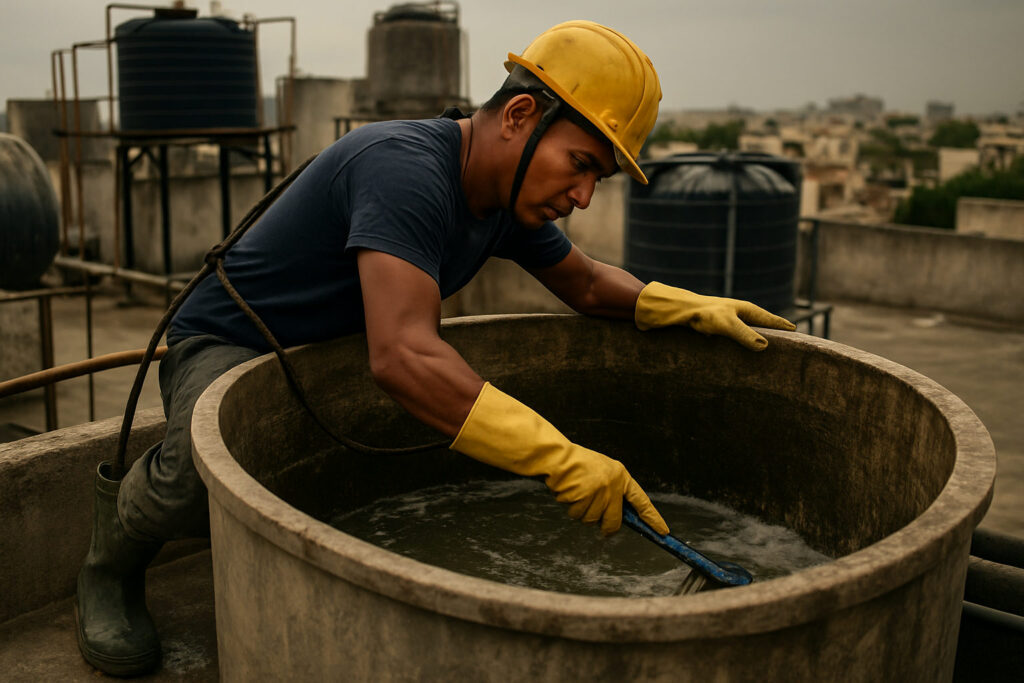
Water tank cleaning in South Delhi runs about ₹0.80 per litre for standard jobs. That means a 1,000-litre overhead tank costs around ₹800 to ₹1,000. A 5,000-litre underground sump? ₹4,000 to ₹5,000. The price shifts depending on tank type, how much sludge has built up, and whether you go with traditional jet-wash or the newer non-invasive approach. This guide breaks down what you’ll actually pay in Hauz Khas, Greater Kailash, Vasant Kunj, and how to pick a service without regrets.
Why South Delhi tanks get dirty faster than you’d expect
Delhi Jal Board water arrives dirty. Sediment, silt, dissolved minerals. All of it settles on the tank floor within weeks. Then summer hits. Standing water in an overhead tank becomes a bacterial breeding ground faster than anywhere cooler. Health guidelines say clean every six months. Most South Delhi households? They go 12 to 18 months. That gap matters.
Rust corrodes from inside older RCC and metal tanks. You’ll find it in colonies like Lajpat Nagar, Malviya Nagar, Saket. The rust mixes into your drinking water. You won’t see it. You might taste it. Your water filter catches some but not all.
Contaminated tanks cause most urban waterborne illness. A clean tank is the single cheapest preventive step you can take. If you want a fuller regional picture, the water tank cleaning local experts guide for Delhi NCR covers it well.
How much does it cost to clean out a water tank in South Delhi?
₹0.80 per litre. That’s the standard rate for most residential jobs in South Delhi. PR Water Tank Cleaning publishes this openly across Delhi NCR. A 500-litre overhead tank runs about ₹400. A 1,000-litre tank costs ₹800 to ₹1,000. Underground sumps price differently because they take longer to drain and have more surface area to scrub.
| Tank Type | Capacity | Typical Price Range (South Delhi) |
|---|---|---|
| Overhead (rooftop) | 500 litres | ₹400 to ₹500 |
| Overhead (rooftop) | 1,000 litres | ₹800 to ₹1,000 |
| Underground sump | 3,000 litres | ₹2,400 to ₹3,000 |
| Underground sump | 5,000 litres | ₹4,000 to ₹5,000 |
| Septic tank (residential) | Varies | ₹3,000 to ₹5,000 per visit |
Septic tanks run higher. Justdial listings for South Delhi show ₹3,000 to ₹5,000 per residential visit. Sludge volume and tank condition vary wildly. For a detailed cost comparison across all Delhi, check the water tank cleaning charges price guide before you book.
Traditional cleaning vs. non-invasive: what’s actually different
This is the choice most South Delhi residents don’t know they have.
Traditional cleaning: drain the tank fully. A technician climbs in (for large underground sumps). Scrubs walls with brushes. Hits it with high-pressure jets to blast off debris. Disinfects with chemicals. It works. It also wastes the entire tank’s water and involves chemical contact with the interior.
Non-invasive cleaning is different. A motorised brush mounted on an insertion pipe does the scrubbing. No human enters the tank. A submersible pump extracts the sludge-water slurry. The process uses only 25% to 30% of the tank’s water, leaving 70% to 75% clean and undisturbed. GD Water Consult has run this method in South Delhi since 2013. In summer, when refilling a 5,000-litre sump from DJB supply takes a full day, the water conservation angle matters.
Which should you pick? Non-invasive wins for overhead tanks and homes with young children or pets (no chemical residue risk). Traditional jet-wash makes sense for heavily neglected underground sumps that need a full physical scrub to shift years of compacted silt. Most first-time cleans on tanks older than two years benefit from traditional methods. After that, non-invasive maintenance keeps things clean with less disruption.
How to clean a 20,000-litre water tank (step by step)
A 20,000-litre underground sump is standard in larger South Delhi housing societies, especially in Vasant Kunj, Green Park, Greater Kailash II. This isn’t a DIY job. But knowing the process helps you verify that a hired crew is actually doing the work properly.
- Turn off the pump. Shut down the submersible or borewell pump feeding the tank. You need the water level static during cleaning so sediment doesn’t get stirred back into the main supply line.
- Inspect via the access hatch. Most large underground sumps have an inspection hatch at the top. Open it. Check the sludge depth at the floor. Look for visible algae on the walls. Note any cracks or corrosion. This tells you whether a standard clean will do or whether structural repairs are needed alongside.
- Extract sludge and standing water. Use a submersible sludge pump or a wet vacuum to pull out the floor-level muck. For a 20,000-litre tank, expect 400 to 800 litres of sludge water. Non-invasive operators do this with the insertion system. Traditional crews use a dewatering pump after partial drainage.
- Scrub internal surfaces. Walls, floor, and any baffles inside get scrubbed with stiff brushes or the motorised brush attachment. Pay attention to corners and inlet/outlet points where biofilm builds up fastest.
- Allow sediment to resettle, then pump out again. After the first scrub, fine particulates cloud the remaining water. Let it settle for 20 to 30 minutes, then run the sludge pump a second time to pull out what’s sunk back to the floor.
- Disinfect. Non-invasive operators skip this or use minimal amounts (food-grade only). Traditional services apply an anti-bacterial agent to the interior walls. Either way, the tank gets flushed once before reconnecting to the supply line.
- Reconnect and test. Refill, restart the pump, and run a tap at the furthest point in the building for two minutes before declaring the job complete. Cloudy water for more than a minute means the tank needs a second flush.
Budget two to three hours for a society-level 20,000-litre job. Expect two technicians. Anything quoted at under 90 minutes is probably incomplete.
Neighbourhoods where demand is highest (and what that means for you)
South Delhi isn’t one market. It’s a dozen micro-markets with different water supply quality, different building ages, different tank types.
Hauz Khas and Greater Kailash have older RCC tanks from the 1980s and 1990s construction boom. These tanks corrode. They need cleaning at least twice a year. Malviya Nagar and Saket are mixed. Newer apartment blocks have polyethylene tanks (less corrosion, easier to clean). Older kothi-style properties have brick-lined underground sumps that are genuinely difficult to access.
Vasant Kunj is different. Most DDA flats here have mid-size overhead tanks (1,000 to 2,000 litres) that are straightforward to service. Dwarka, technically South-West rather than South but served by the same operators, has some of the largest underground sumps in the residential sector. Getting reliable service in Dwarka often means calling a company based in Greater Kailash or Malviya Nagar and confirming they cover the area.
If your plumbing shows discoloured water alongside a neglected tank, check whether the pipes themselves need attention. A plumber in South Delhi can assess whether the discolouration is coming from the tank, the pipes, or both.
What to check before you book any service
The market is crowded and uneven. Google search for “water tank cleaning in South Delhi near me” returns dozens of results. Established operators with 10+ years of history. WhatsApp numbers with no verifiable track record. Here’s how to filter fast.
- Google reviews, not just star rating. Look at the review count. A 4.9 with 12 reviews is less useful than a 4.6 with 140 reviews. Read the one-star reviews specifically. Do they mention no-shows, incomplete work, surprise charges?
- Ask: does your price include disinfection, or is that extra?
- Confirm they carry a waste disposal certificate. Sludge removed from your tank has to go somewhere legal. Operators who dump it in the street drain are a liability for your building.
- Get the price in writing via WhatsApp before the crew arrives. Verbal quotes that balloon on-site are a known issue in this category.
- For society-level jobs: check whether the operator has experience with RWA (Resident Welfare Association) bookings. Some individual-home operators aren’t set up to handle multi-tank society jobs efficiently.
One more thing: free water tank cleaning schemes do exist in South Delhi. The Delhi government has run free cleaning drives through the Delhi Jal Board for registered residential properties. These are sporadic, not guaranteed, and require advance registration with your local ward. Don’t plan your cleaning schedule around them. It’s worth checking with your local DJB office whether any programme is currently active for your colony.
Frequently Asked Questions
How much does it cost to clean out a water tank in South Delhi?
Most operators in South Delhi charge around ₹0.80 per litre. That puts a 1,000-litre overhead tank at ₹800 to ₹1,000 and a 5,000-litre underground sump at ₹4,000 to ₹5,000. Septic tank cleaning runs higher, typically ₹3,000 to ₹5,000 per residential visit, depending on sludge volume and tank condition. Always confirm whether the quoted price includes disinfection before booking.
How do you clean a 20,000-litre water tank?
A 20,000-litre underground sump needs at least two technicians and two to three hours. The process: shut down the inlet pump, inspect the tank via its access hatch, extract sludge with a submersible pump or wet vacuum, scrub all internal surfaces (walls, floor, baffles), allow fine sediment to resettle and pump out again, disinfect the interior, then refill and flush before reconnecting to the building supply. Non-invasive operators use a motorised brush on an insertion pipe and preserve 70% to 75% of the tank’s water during the process.
How often should water tanks be cleaned in South Delhi?
Every six months is the standard recommendation for South Delhi households. DJB supply carries sediment and dissolved minerals that settle over time. Summer heat accelerates bacterial growth. Most households stretch to 12 to 18 months, which is too long. If your water has any taste, odour, or colour change, don’t wait for the six-month mark.
What is the difference between non-invasive and traditional water tank cleaning?
Traditional cleaning drains the tank fully, uses high-pressure jets and manual scrubbing, and often involves chemical disinfectants. It works but wastes the entire tank volume. Non-invasive cleaning uses a motorised brush on an insertion pipe with no human entry into the tank. It preserves 70% to 75% of the water already in the tank and avoids direct chemical contact. Non-invasive is better for routine maintenance. Traditional jet-wash makes more sense for heavily neglected tanks with compacted silt.
Are there free water tank cleaning services in South Delhi?
The Delhi government has run free cleaning drives through the Delhi Jal Board for registered residential properties on a periodic basis. These are not guaranteed or regularly scheduled. Check with your local DJB ward office to see if any programme is currently active for your colony. Do not build your maintenance schedule around them.
The fastest way to find a reliable service near you
Search “water tank cleaning in South Delhi” on Google Maps. Filter for businesses with 50+ reviews. Call two of them. Ask for a WhatsApp quote. Compare. The whole process takes 15 minutes. The difference between a ₹800 clean and a ₹1,500 clean for the same 1,000-litre tank is real in this market. The higher price doesn’t always mean better work.
For before-and-after results on different tank conditions, this photo guide to water tank cleaning in Delhi is the most useful visual reference available.
Book, get it done, set a calendar reminder for six months from now.